Genesis 6:9–11:32 — the flood, the ark, the covenant of the rainbow, Babel, and ten generations to Abram
Mega Bible parasha sheet theothermatthewmiller.com
The parasha by the numbers
153
verses
1862
words
410
distinct roots
13
hapax legomena
Most frequent roots
כֹּלall, every
78
אֶרֶץland, earth
61
בֵּןson
48
עַלupon, over
42
יָלַדhe begot, bore
37
נֹחַNoah
36
אֲשֶׁרwho, which
36
הָיָהto be, become
34
שָׁנָהyear
34
תֵּבָהark, box
26
Averaging 12.2 words a verse. The longest verse is
8:21 at 32 words
— God's own resolve never again to curse the earth because of humanity, reasoning through the very
impulse that caused the flood; the shortest,
8:15, has only 5
— the bare formula introducing what God says next.
What the parasha calls God
אֱלֹהִיםGod
18
ה'the Name (Hashem)
14
אֱלֹהִים (Elohim) narrowly outnumbers ה' across the
parasha — the same two-name interplay as Bereshit, din (judgment: the decision to flood) and
rachamim (mercy: the decision, after, never to again) trading the story back and forth.
Thirteen words that occur nowhere else in the Bible
6:14גֹפֶר‹גֹּפֶר›H1613
gopher-wood — of unknown species, used nowhere else
8:11טָרָףH2965
freshly plucked (the olive leaf)
8:22וְקֹר‹קֹר›H7120
cold
10:10וְאֶרֶךְ‹אֶרֶךְ›H751
Erech (Uruk), a city of Nimrod's kingdom
10:10וְאַכַּד‹אַכַּד›H390
Accad (Akkad), a city of Nimrod's kingdom
10:12רֶסֶןH7449
Resen, a city between Nineveh and Calah
10:19לָשַׁע‹לֶשַׁע›H3962
Lesha, a border-town of the Canaanites
10:23וָמַשׁ‹מַשׁ›H4851
Mash, a son of Aram
10:28עוֹבָלH5745
Obal, a son of Joktan
10:30מִמֵּשָׁא‹מֵשָׁא›H4852
Mesha, a boundary-point of Joktan's territory
10:30סְפָרָה‹סְפָר›H5611
Sephar, a mountain marking that territory's edge
11:29יִסְכָּהH3252
Jiskah, Abram's niece
11:30וָלָדH2056
child, offspring
Hapax legomena, counted against the whole Tanakh: thirteen of this parasha's 410
roots are used exactly once in all of Scripture, and 199 more appear only once here.
Nine of the thirteen are place- or personal names buried in the Table of Nations — the parasha's rarest
vocabulary isn't the flood at all, but the roll call of everyone the flood's survivors became.
Counts computed from the OSHB/WLC morphology across the full Tanakh1 / 2
Biblical → Modern Hebrew
6:14תֵּבָה
the vessel that carries Noah's family through catastrophe becomes the ordinary word for any sealed container
עֲשֵׂה לְךָ תֵּבַת עֲצֵי־גֹפֶר — the word for Noah's vessel, תֵּבָה, was never a specialized nautical term; the very same word names the little basket of reeds and pitch that carries the infant Moses down the Nile (Exodus 2:3). In Modern Hebrew it has stayed exactly that ordinary: a תֵּבָה is any enclosed box or case — a mailbox is a תיבת דואר, a music box a תיבת נגינה, an email inbox a תיבת דואר נכנס. The specific idiom תיבת נח keeps Noah's version alive on its own terms, though: Israelis use it for any space crammed with every conceivable kind of person or thing thrown together at once — a packed commuter train, a chaotic moving day, a fractious coalition government are all, affectionately or not, called a תיבת נח.
11:9בָּלַל
the verb for God's confusion of languages at Babel gives Modern Hebrew its ordinary word for confusion itself
עַל־כֵּן קָרָא שְׁמָהּ בָּבֶל כִּי־שָׁם בָּלַל ה' שְׂפַת כָּל־הָאָרֶץ — the text supplies its own etymology: Babel (בָּבֶל) is named for the verb בָּלַל, "to confuse, to mix up." Modern Hebrew took the root and ran with it: לְבַלְבֵּל means to confuse someone, and the noun בִּלְבּוּל — built straight off the Biblical root — is the everyday word for confusion or a mix-up, with none of the original's theological weight left: a בלבול can be a scheduling mix-up, a mental fog, or a toddler's tantrum. The Hungarian psychoanalyst Sándor Ferenczi's landmark 1933 paper on childhood trauma was published in Hebrew translation under exactly this word — בלבול השפות בין המבוגרים לילד ("Confusion of Tongues Between the Adult and the Child"), held today in the National Library's catalogue — extending Babel's own confusion of tongues into a clinical term for a child mistaking an adult's language of desire for the language of tenderness.
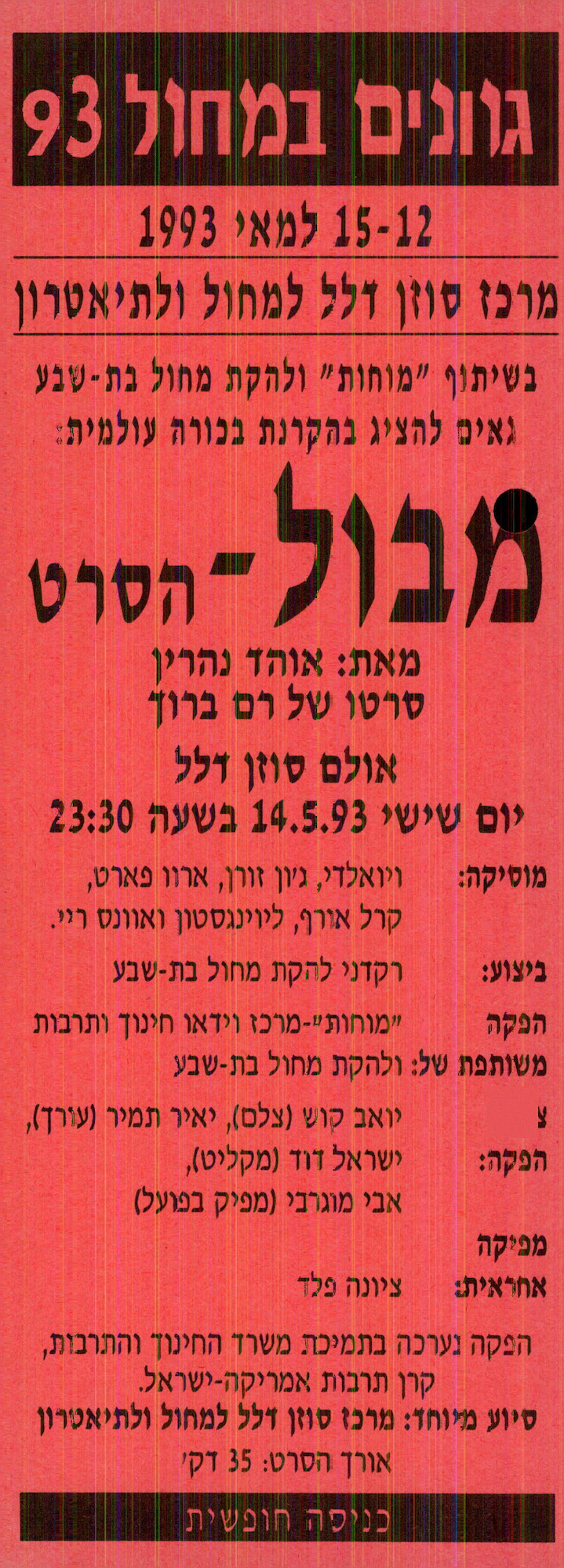
Suzanne Dellal Centre for Dance and Theatre Archive / Batsheva Dance Company, National Library of Israel, 1993 FL58235059
6:17מַבּוּל
the word for Noah's own catastrophe becomes Modern Hebrew's ordinary word for any overwhelming deluge
וַאֲנִי הִנְנִי מֵבִיא אֶת־הַמַּבּוּל מַיִם עַל־הָאָרֶץ — מַבּוּל appears in the Torah nowhere outside Noah's own story (it returns only once more, in Psalms 29:10, remembering it). In Modern Hebrew it is entirely unremarkable: a מבול is any overwhelming flood — a מבול של תגובות ("a flood of responses"), a מבול של תיירים ("a flood of tourists"), a מבול של מידע ("an information deluge") — the word keeping its sense of being overwhelmed all at once while shedding its cosmic scale. In 1993 the Suzanne Dellal Centre for Dance and Theatre programmed a screening of מבול — הסרט ("The Flood — the Movie"), Ram Baruch's film of Ohad Naharin's own dance piece מבול; the surviving festival flyer, preserved in the National Library's dance archive, uses the word exactly as Genesis does — total, engulfing, and needing no further explanation.
Attested · National Library of Israel · 1993
עלון - 'מבול - הסרט'
Festival flyer for Ram Baruch's film of Ohad Naharin's dance piece "Mabul" (The Flood), screened at the Suzanne Dellal Centre, May 1993.
Eight narrative units, by word count
עִוּוּת וְהַהַחְלָטָה
Corruption & the decision
189 words
טְעִינַת הַתֵּבָה
Loading the ark
227 words
הַמַּבּוּל
The flood
297 words
הַבְּרִית וְהַקֶּשֶׁת
Covenant & rainbow
349 words
שִׁכְרוּת נֹחַ
Noah's drunkenness
121 words
טַבְלַת הָעַמִּים
Table of Nations
287 words
מִגְדַּל בָּבֶל
Tower of Babel
121 words
מִשֵּׁם עַד אַבְרָם
Shem to Abram
271 words
The covenant and the rainbow run longer than any other unit — the story pausing to spell out its own
moral before moving on. The Tower of Babel is tied for the shortest unit in the whole parasha, exactly
matching Noah's drunkenness: nine verses is all it takes to scatter the entire human race across the
earth, despite being the parasha's most famous story after the flood itself.
My notes
Nothing recorded yet — the notes field is empty for every verse of Genesis 6:9–11:32.
Modern-usage notes traced through Ma'agarim · ephemera and archive scans from the National
Library of Israel (מאוסף הספרייה הלאומית), used under the Library's
fair-use terms2 / 2